
Most marketing teams are not asking “should we use AI?” anymore. They are asking “why is AI not moving our revenue yet?”
Fresh research from IAB Europe (its 2026 study, run across 50 ad executives in 44 European markets and reported by Digiday on September 24, 2026) gives us the clearest picture so far of where AI in marketing really stands. And the numbers tell a story most vendors will not put in their pitch decks.
AI marketing adoption in 2026: nearly universal, mostly shallow
Start with the headline: 86% of the surveyed executives (43 out of 50) say their organization already uses AI for marketing. Adoption is not the story anymore. Depth is.
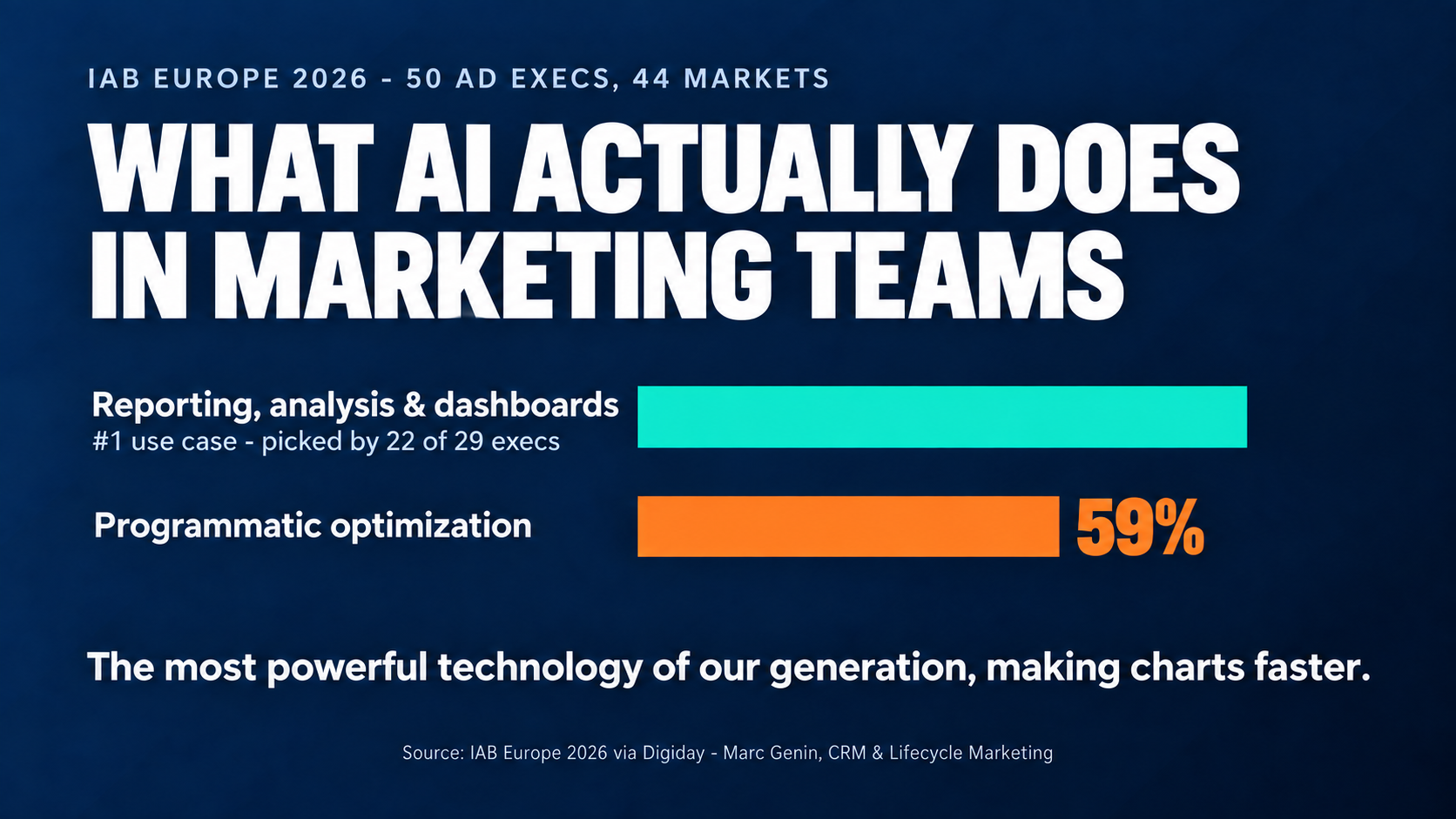
Ask what those teams actually do with AI, and the answer is surprisingly modest. The number one AI-supported workflow, picked by 22 of 29 executives, is reporting, analysis and dashboards. Programmatic optimization comes next at 59%.
In other words: the most common use of the most powerful technology of our generation is making charts faster.
That is not a criticism. Reporting is exactly where AI pays back fastest, because it is repetitive, rules-based and easy to measure. But it explains the next number.
How marketing teams measure AI success: efficiency, not outcomes
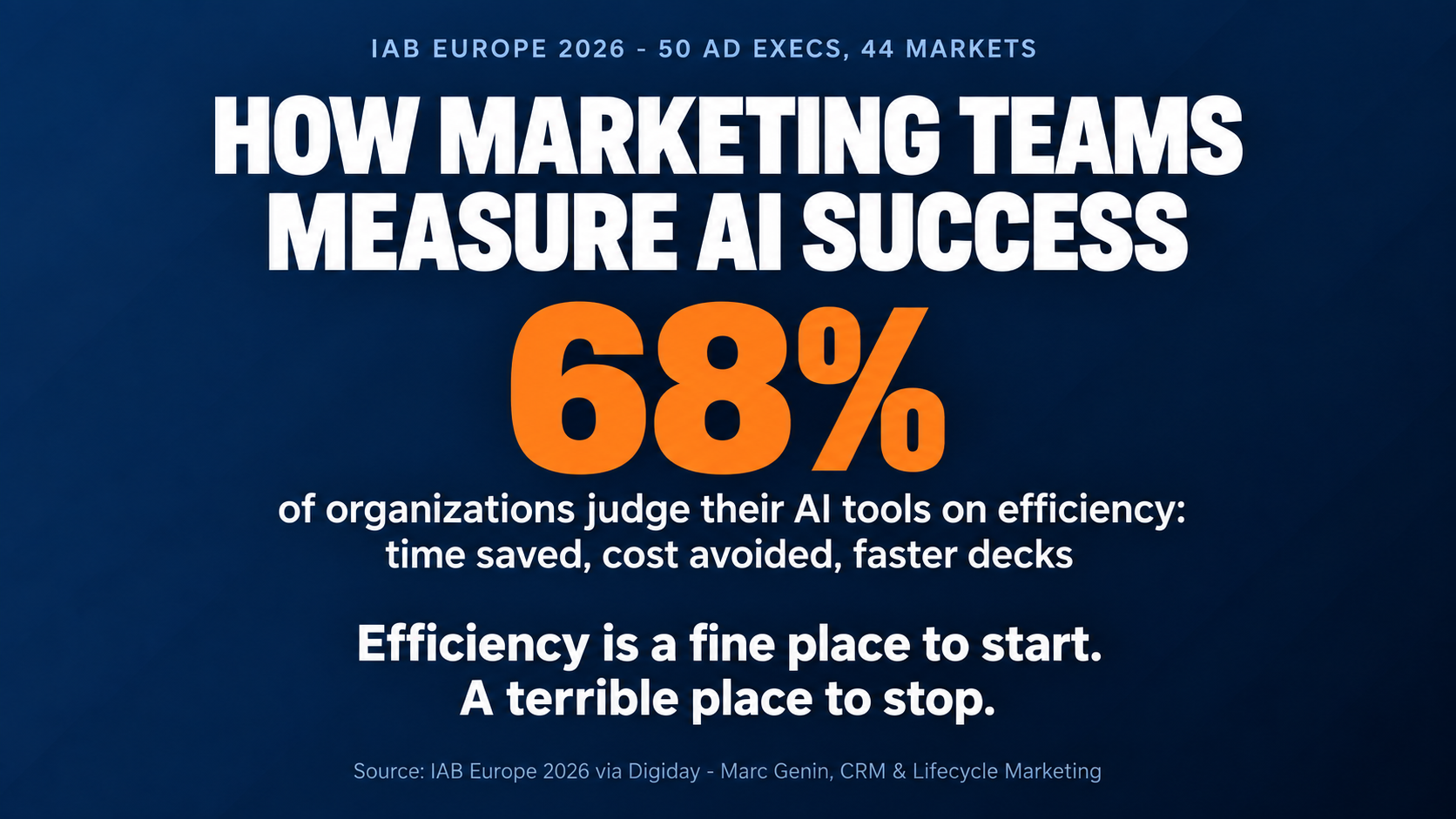
When IAB Europe asked how organizations judge their AI tools, 68% of respondents said efficiency. Time saved. Cost avoided. Faster decks.
Efficiency is a fine place to start. It is a terrible place to stop.
A CRM or lifecycle program judged only on efficiency will optimize what you already do. It will not find the customers you are losing, the journeys you are not running, or the revenue sitting in segments you have never built. If your AI strategy ends at “we produce reports faster”, you are automating the past, not building the future.
The AI marketing size gap: 86% vs 48%
Here is the finding that matters most if you run or advise a small or mid-sized business.
Among companies with more than 500 employees, 86% already run their most advanced AI systems at a level where people and AI agents plan, delegate and execute work together. Among companies with 500 staff or fewer, that number drops to 48%.
Same technology. Same year. A 38-point gap.
Large organizations are buying their way into agentic workflows with dedicated teams and budgets. SMBs are not behind because they lack ambition. They are behind because nobody has shown them which three or four use cases actually pay for themselves at their scale.
Agentic AI in marketing: real, but earlier than the hype
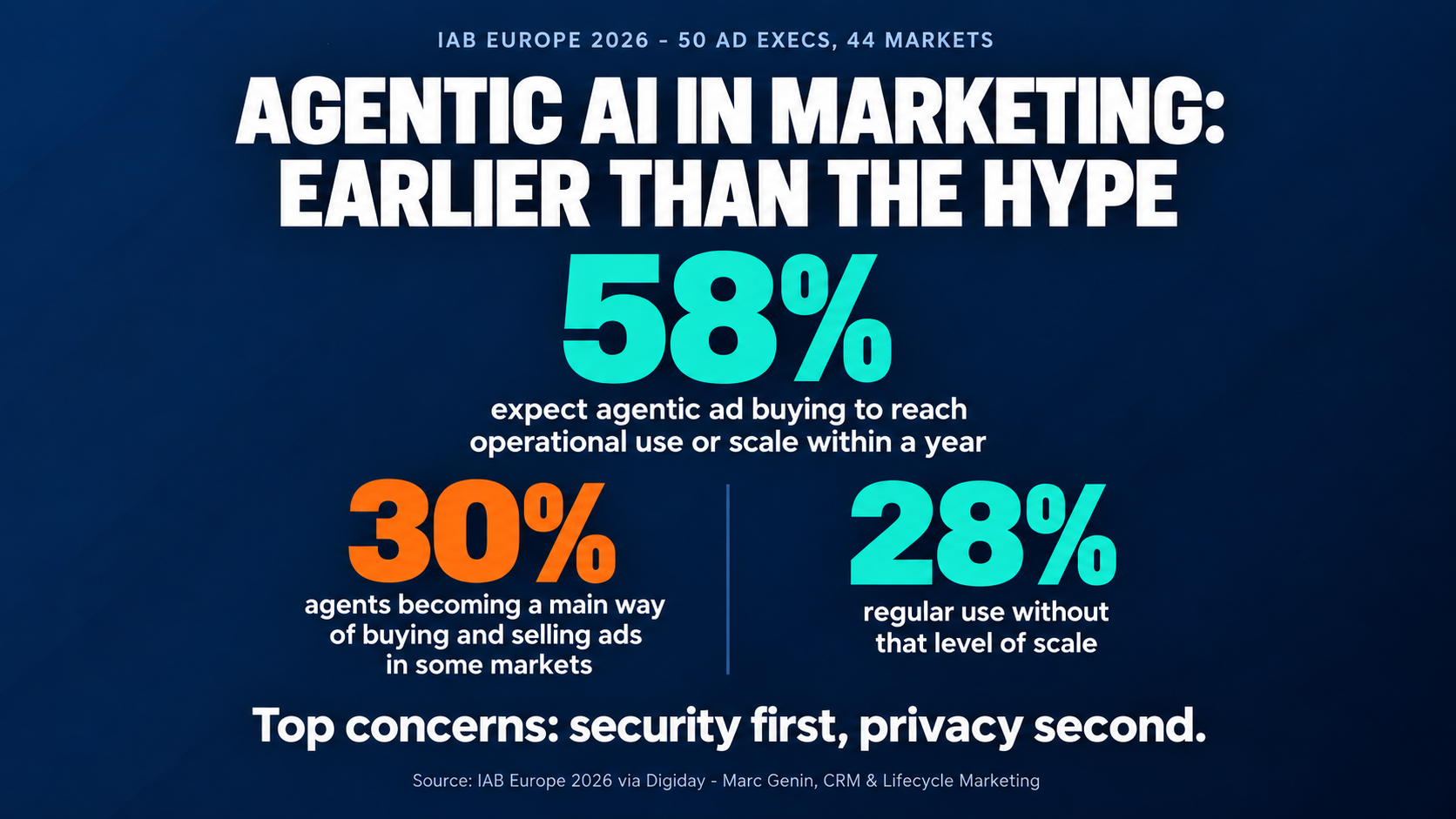
The study also cuts through the agentic AI noise. 58% of executives expect agentic ad buying to reach operational use or scale within a year, but the details matter:
- 30% expect AI agents to become a main way of buying and selling ads in some markets
- 28% expect regular use without that level of scale
- The rest expect further development with little day-to-day impact yet
And 36 of 47 executives say their organization either has no agentic system running day to day, or has one that humans still direct and plan alongside. The top concerns? Security first, privacy second.
So yes, agentic AI is coming to marketing. No, it is not running your campaigns while you sleep. Not yet, and not without supervision.
How SMBs close the AI marketing gap (without a bigger budget)
The good news: closing the gap is not a budget problem. It is a use-case problem. Here is the playbook I recommend to CRM and lifecycle marketing clients:
- Start where AI already wins. Reporting and analysis automation is proven, cheap and fast. Use it to free 5 to 10 hours a week, then reinvest those hours in the steps below.
- Wire AI into your CRM, not just your dashboards. The gap between “AI that reports” and “AI that sells” is data. Connect AI to your customer data platform or CRM so it can act on lifecycle stage, behavior and purchase history, not just describe them.
- Pick revenue use cases, not efficiency use cases. Churn-risk triggers, win-back journeys, next-best-offer personalization, lead scoring. These are the workflows where SMBs can match enterprise results, because they depend on focus, not headcount.
- Keep humans in the loop. Every serious operator in the study does. AI drafts, scores and flags. You decide. That is how you get speed without the security and privacy risks that worry executives most.
- Measure outcomes, then efficiency. Judge AI on revenue per campaign, retention rate and conversion lift first. Let efficiency be the bonus, not the goal.
The companies that win the next two years of AI marketing will not be the ones with the biggest AI budgets. They will be the ones that picked the right three use cases and wired them into their CRM properly. That game is wide open for SMBs, and 48% versus 86% is an opportunity, not a verdict.
I help SMBs and scale-ups build CRM and lifecycle marketing programs that turn AI from a reporting tool into a revenue engine. If you want a clear-eyed audit of where AI fits your stack, get in touch or explore my CRM playbooks.
Source: IAB Europe 2026 study, via Digiday, September 24, 2026: