
AI Agents Now Run Lifecycle Marketing: What Meta Muse + Klaviyo Means for SMBs
Your email platform used to wait for you to log in. This week, it started asking for a job.
On September 29, 2026, Meta announced Muse for Small Business, its personal AI agent for consumers and SMBs. Klaviyo, the lifecycle marketing platform, is one of its launch partners. Connect the two, and an AI agent can analyze your customer data, draft your campaigns, build your flows, schedule your sends, and watch your revenue while you sleep.
If you run CRM or lifecycle marketing for a small or mid-sized business, this is not another AI feature to ignore. It is the first mass-market version of a model I have been recommending to clients for two years: agents do the monitoring and the drafting, humans keep the judgment and the approval.
Here is what actually launched, and how to use it without handing your brand to a robot.
What Meta Muse can do with Klaviyo, in plain terms
The integration, detailed on Klaviyo's own blog on September 29, covers four jobs:
- Conversational insights. Ask Muse questions in plain language about your campaigns, flows, segments and revenue, and it answers from your actual Klaviyo data. Which flow drives the most revenue? Which customers are starting to disengage? You get the answer in the same chat where you act on it.
- Marketing execution. Muse can draft campaigns, configure welcome flows and their triggers, and schedule sends. Every one of these lands as a draft for your approval, not as a live send.
- Ongoing monitoring. Give Muse standing jobs: watch flow performance, flag conversion drops, send you a weekly summary. It keeps working after the conversation ends.
- Cross-platform work. Because Muse also sees your Instagram and Facebook, it can spot people posting about your products and help turn that attention into subscribers and campaigns inside Klaviyo.
Klaviyo is not betting on one agent, either. Its own built-in marketing agent, Composer, lives inside the platform, and connectors let your Klaviyo data follow you into ChatGPT, Claude, or Shopify Sidekick. The pattern is clear: your customer data becomes the context layer, and whichever AI agent you prefer does the work on top of it.
Three use cases that pay for themselves first
Klaviyo's announcement includes five scenarios. Three of them map directly to the highest-ROI lifecycle work I see at SMBs:
The 2 a.m. revenue rescue. Your abandoned cart flow breaks at midnight: a discount code expires, a link 404s. In Klaviyo's example, you would normally find out in Monday's report and lose 48 hours of revenue. With monitoring, the agent tells you conversion dropped and what changed, and you fix it over morning coffee. Their suggested prompt: "Keep an eye on my Klaviyo flows. If conversion drops more than 20% in a day, tell me what changed."
The 10-minute welcome series. A proper 3-email welcome series takes a marketer about half a day: copy, timing logic, trigger conditions, testing. So most SMBs ship a weak one, or none. Now the agent drafts the copy, sets up the flow logic and triggers, and hands you a finished build to approve.
The win-back you never had time for. Every SMB has customers who bought twice and disappeared. The agent can pull that segment out of your data (bought twice, nothing in 90 days, in their example), tell you what those customers used to buy, and draft a win-back email that references the actual products.
Notice what these three have in common: none of them is strategy. They are monitoring, drafting and data-pulling, the exact work that eats SMB marketing hours without needing senior judgment.
The approval model is the feature
Read the launch details carefully and one design decision stands out: everything customer-facing stops at a draft. Campaigns are drafted. Flows are configured. Sends are scheduled. Then a human approves.
That is not a limitation. That is the correct architecture for AI in lifecycle marketing, and it is the answer to the question I get most from SMB owners: "how do I use AI without it sending something stupid to my entire list?" You let the agent do the expensive 90% (watching, pulling, drafting, configuring) and you keep the cheap, critical 10% (judgment, taste, brand voice, the final yes).
It also mirrors what the data says about who wins with AI. In IAB Europe's 2026 research, the organizations furthest ahead are not the ones that removed humans from the loop. They are the ones running human+AI workflows where people and agents plan, delegate and execute together. Big companies build those workflows with dedicated teams. Integrations like Muse + Klaviyo hand the same operating model to a five-person business for the price of the tools it already has.
Where I would start, and where I would not
If you run Klaviyo today, here is the order I would roll this out with clients:
- Monitoring first. Turn on flow monitoring with a simple drop-alert prompt before you let the agent draft anything. It is read-only on your revenue, it finds real money (broken codes, dead links, expired offers), and it teaches you how the agent reads your account.
- Drafting second. Have it build one welcome series or one win-back campaign. Review it the way you would review a junior marketer's work: structure usually good, voice usually needs a pass.
- Analysis third. Ask it the analyst questions you never get to: which product creates repeat buyers, which channel pays for itself, email versus SMS revenue over six months.
- Not yet: unattended sends. Keep the approval step. The day you remove it is the day a hallucinated discount code goes to your whole list at 2 a.m., and the agent will not be the one apologizing to your customers.
The bigger picture: lifecycle marketing is the first marketing discipline where "the platform runs itself" is becoming literally true, because the data is structured, the playbooks are known, and the ROI is measurable. The SMBs that win the next two years will not be the ones with the biggest budgets. They will be the ones that wired an agent into their CRM early, on the right three use cases, with a human still holding the keys.
Build the lifecycle engine these agents plug into.
My PDF playbook Lifecycle CRM for Small Teams (Guide 01) gives you the exact CRM setup, flows and data model to run lifecycle marketing - with or without an AI agent doing the chasing.
Get the PDF playbook
I help SMBs and scale-ups build CRM and lifecycle marketing programs that turn AI from a reporting tool into a revenue engine. If you want a clear-eyed audit of where agents fit your stack, get in touch or explore my CRM playbooks.
Source: Klaviyo blog, "Klaviyo + Meta Muse: Let an AI Agent Run Your Campaigns and Flows", September 29, 2026:
https://www.klaviyo.com/blog/klaviyo-meta-muse-connector


AI in Marketing 2026: Big Companies Run AI at 86%, SMBs at 48% - Here Is How to Close the Gap
Most marketing teams are not asking "should we use AI?" anymore. They are asking "why is AI not moving our revenue yet?"
Fresh research from IAB Europe (its 2026 study, run across 50 ad executives in 44 European markets and reported by Digiday on September 24, 2026) gives us the clearest picture so far of where AI in marketing really stands. And the numbers tell a story most vendors will not put in their pitch decks.
AI marketing adoption in 2026: nearly universal, mostly shallow
Start with the headline: 86% of the surveyed executives (43 out of 50) say their organization already uses AI for marketing. Adoption is not the story anymore. Depth is.
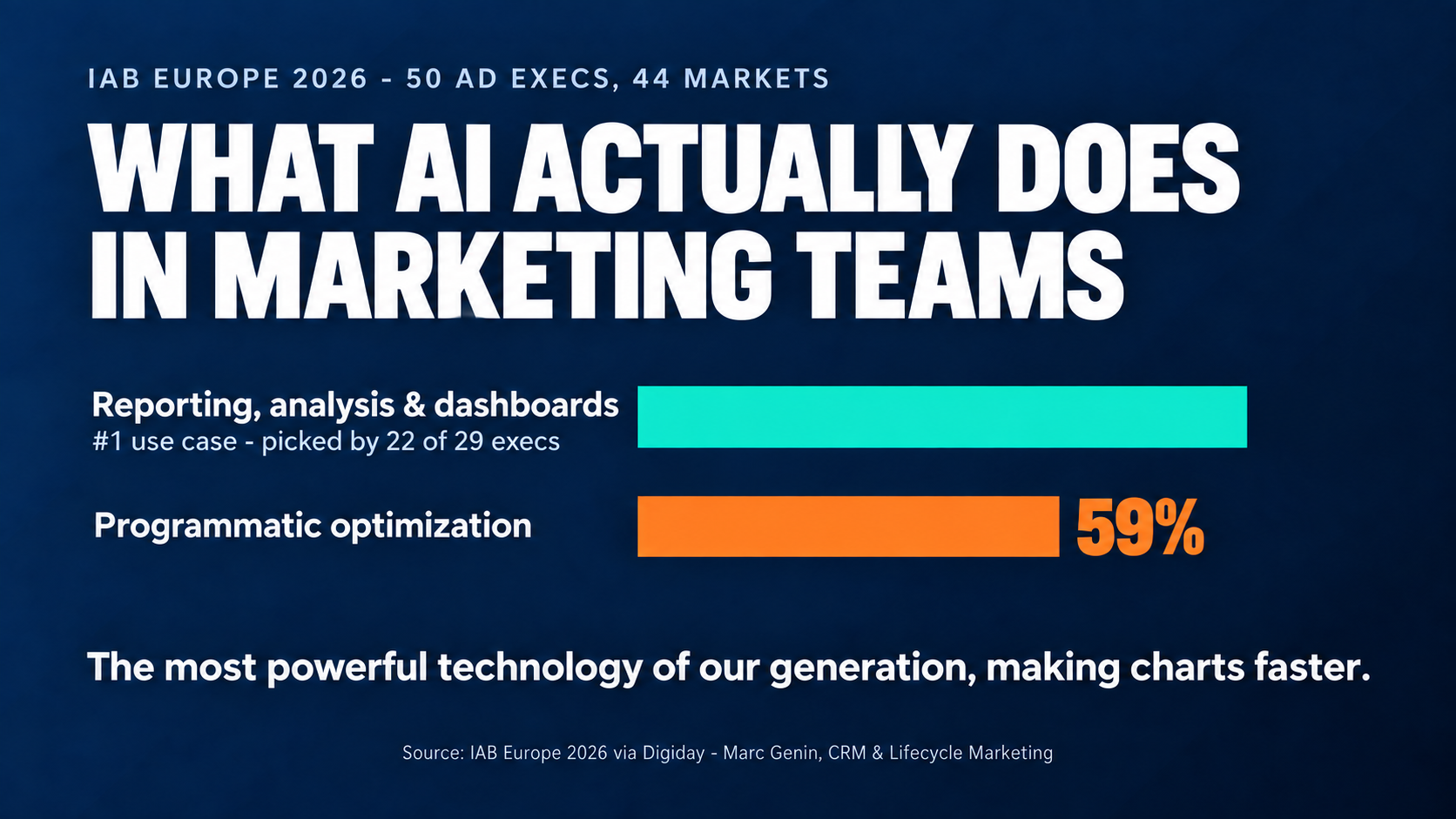
Ask what those teams actually do with AI, and the answer is surprisingly modest. The number one AI-supported workflow, picked by 22 of 29 executives, is reporting, analysis and dashboards. Programmatic optimization comes next at 59%.
In other words: the most common use of the most powerful technology of our generation is making charts faster.
That is not a criticism. Reporting is exactly where AI pays back fastest, because it is repetitive, rules-based and easy to measure. But it explains the next number.
How marketing teams measure AI success: efficiency, not outcomes
When IAB Europe asked how organizations judge their AI tools, 68% of respondents said efficiency. Time saved. Cost avoided. Faster decks.
Efficiency is a fine place to start. It is a terrible place to stop.
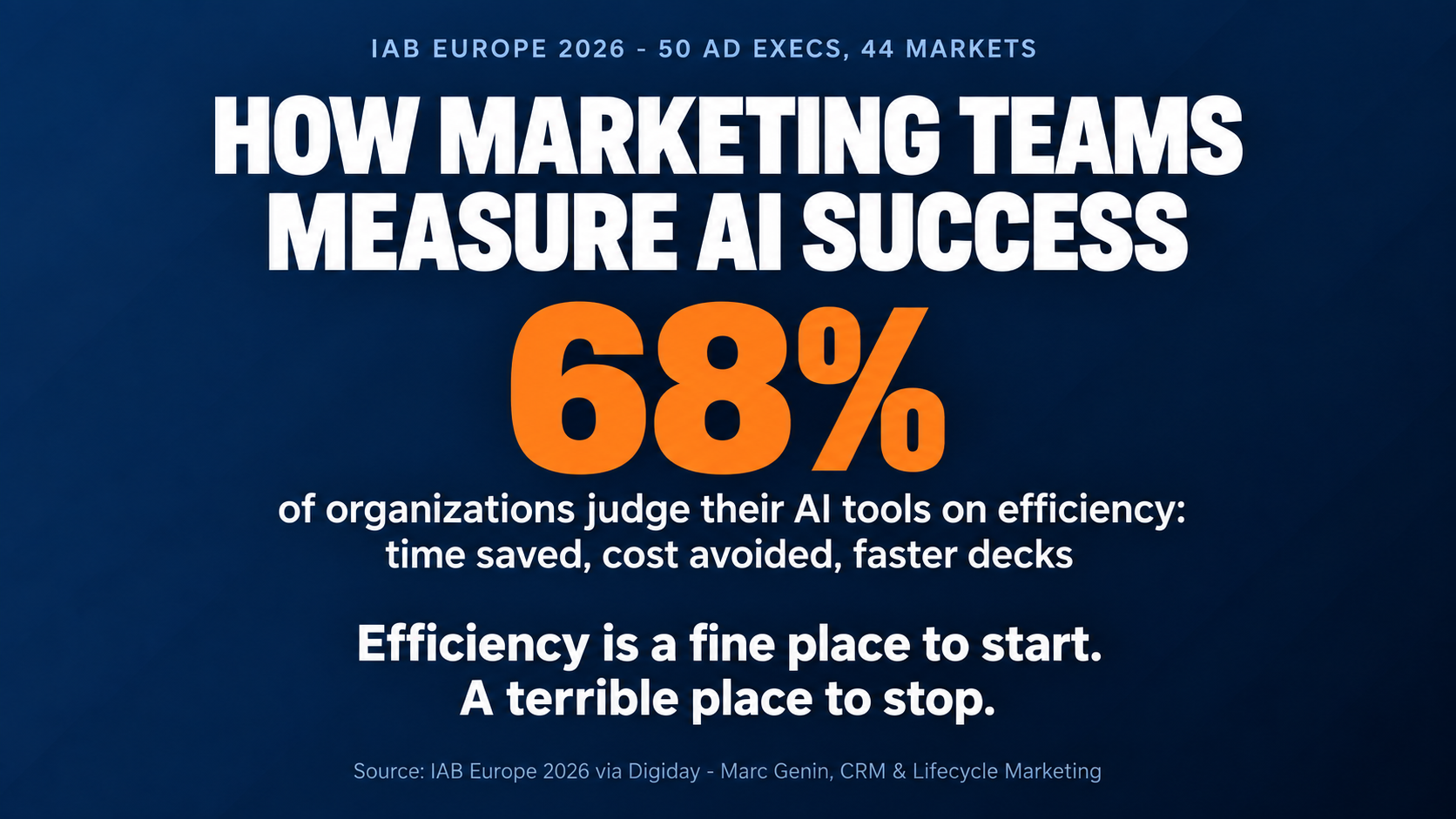
A CRM or lifecycle program judged only on efficiency will optimize what you already do. It will not find the customers you are losing, the journeys you are not running, or the revenue sitting in segments you have never built. If your AI strategy ends at "we produce reports faster", you are automating the past, not building the future.
The AI marketing size gap: 86% vs 48%
Here is the finding that matters most if you run or advise a small or mid-sized business.
Among companies with more than 500 employees, 86% already run their most advanced AI systems at a level where people and AI agents plan, delegate and execute work together. Among companies with 500 staff or fewer, that number drops to 48%.
Same technology. Same year. A 38-point gap.
Large organizations are buying their way into agentic workflows with dedicated teams and budgets. SMBs are not behind because they lack ambition. They are behind because nobody has shown them which three or four use cases actually pay for themselves at their scale.
Agentic AI in marketing: real, but earlier than the hype
The study also cuts through the agentic AI noise. 58% of executives expect agentic ad buying to reach operational use or scale within a year, but the details matter:
- 30% expect AI agents to become a main way of buying and selling ads in some markets
- 28% expect regular use without that level of scale
- The rest expect further development with little day-to-day impact yet
And 36 of 47 executives say their organization either has no agentic system running day to day, or has one that humans still direct and plan alongside. The top concerns? Security first, privacy second.
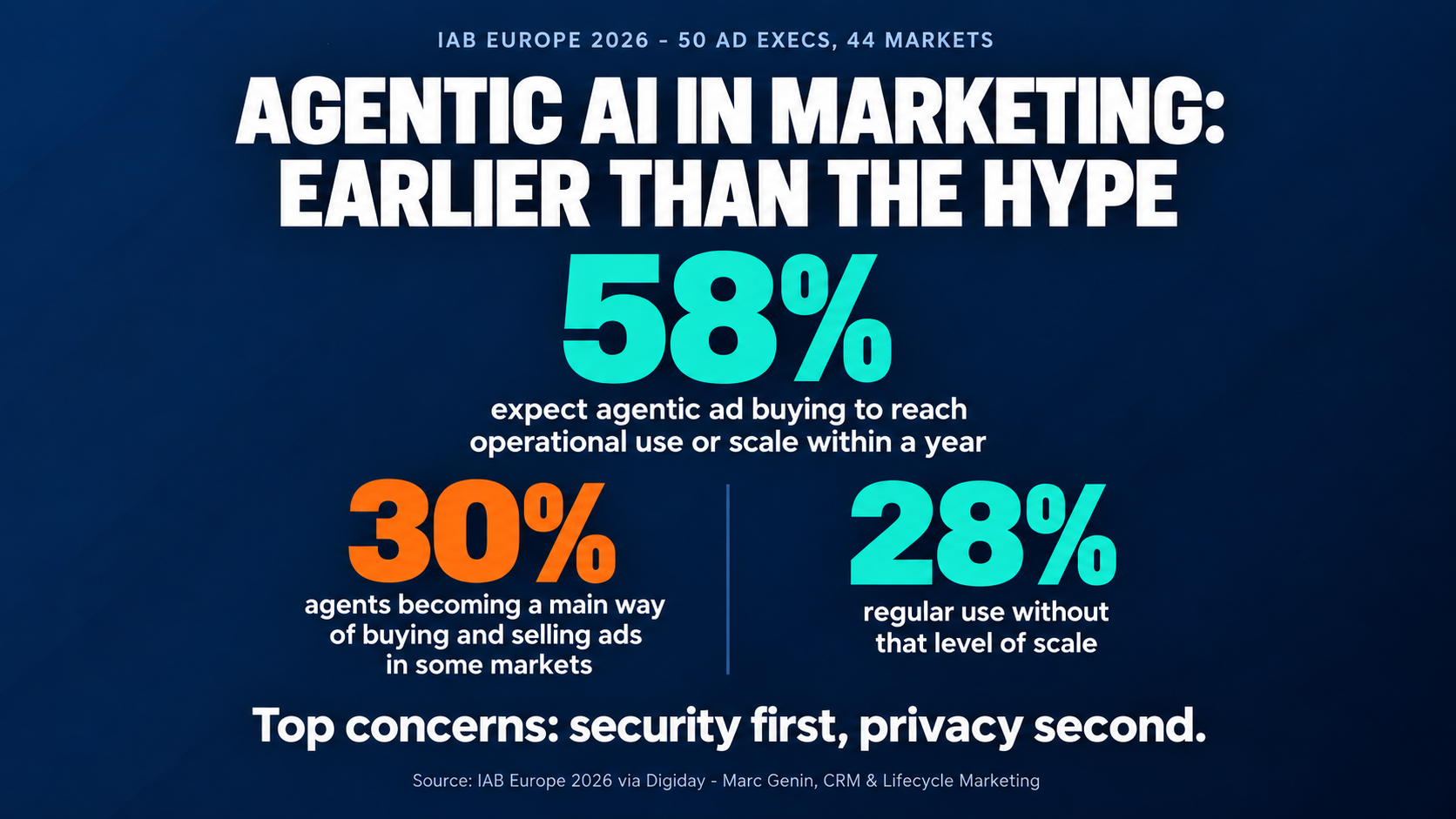
So yes, agentic AI is coming to marketing. No, it is not running your campaigns while you sleep. Not yet, and not without supervision.
How SMBs close the AI marketing gap (without a bigger budget)
The good news: closing the gap is not a budget problem. It is a use-case problem. Here is the playbook I recommend to CRM and lifecycle marketing clients:
- Start where AI already wins. Reporting and analysis automation is proven, cheap and fast. Use it to free 5 to 10 hours a week, then reinvest those hours in the steps below.
- Wire AI into your CRM, not just your dashboards. The gap between "AI that reports" and "AI that sells" is data. Connect AI to your customer data platform or CRM so it can act on lifecycle stage, behavior and purchase history, not just describe them.
- Pick revenue use cases, not efficiency use cases. Churn-risk triggers, win-back journeys, next-best-offer personalization, lead scoring. These are the workflows where SMBs can match enterprise results, because they depend on focus, not headcount.
- Keep humans in the loop. Every serious operator in the study does. AI drafts, scores and flags. You decide. That is how you get speed without the security and privacy risks that worry executives most.
- Measure outcomes, then efficiency. Judge AI on revenue per campaign, retention rate and conversion lift first. Let efficiency be the bonus, not the goal.
The companies that win the next two years of AI marketing will not be the ones with the biggest AI budgets. They will be the ones that picked the right three use cases and wired them into their CRM properly. That game is wide open for SMBs, and 48% versus 86% is an opportunity, not a verdict.
Close the gap without burning your team.
My PDF playbook Marketing Automation That Survives Launch (Guide 03) shows how small teams ship AI marketing automation that keeps working after go-live.
Get the PDF playbook
I help SMBs and scale-ups build CRM and lifecycle marketing programs that turn AI from a reporting tool into a revenue engine. If you want a clear-eyed audit of where AI fits your stack, get in touch or explore my CRM playbooks.
Source: IAB Europe 2026 study, via Digiday, September 24, 2026:
AI Won't Kill Your Job — But It Will Change It Beyond Recognition
AI Won't Kill Your Job — But It Will Change It Beyond Recognition
Let's cut through the noise. Every week, another headline screams that AI is coming for your job. And every week, professionals from Berlin to Sydney sit with that low-grade anxiety, wondering whether their skills will still matter in two years. As someone who has spent over 13 years working at the intersection of digital marketing, CRM automation, and now AI adoption — across markets in Europe, the Middle East, and Australia — I've lived through enough tech disruptions to know that the panic usually precedes the clarity.
A new report from the BCG Henderson Institute offers some of that clarity. The research, published in April 2026, is one of the most rigorous analyses I've come across on what AI will actually do to the labor market. And the headline finding is both reassuring and sobering: AI will reshape more jobs than it replaces. The distinction matters enormously — and most of the discourse around AI and work gets it wrong.
The Numbers Are Big, But the Story Is Nuanced
BCG's microeconomic model, built on data from approximately 165 million US jobs across 1,500 distinct roles, arrives at two figures that every manager, HR director, and professional needs to internalize:
50% to 55% of US jobs will be materially reshaped by AI within the next two to three years. These are roles that persist but transform — same title, radically different daily reality.
10% to 15% of US jobs could be eliminated over the next four to five years. This is real. Significant. And a genuine call to action.
The critical nuance is the word reshaped. Task automation does not automatically equal job elimination. The report draws a sharp line between substitution (AI replaces humans in executing tasks) and augmentation (AI enhances what humans produce). Most roles will fall somewhere on the augmentation side — meaning the job survives, but the skills required to do it well shift substantially.
From a marketing and digital strategy standpoint, this tracks exactly with what I see happening on the ground. The tools have changed. The outputs expected haven't gone away — they've multiplied.
What happens to US jobs under AI — by 2028
The Framework That Cuts Through the Hype
BCG introduces a six-segment model — what they call AI Labor Disruption Segments — and it's genuinely useful as a thinking tool. Here's how I'd translate each for practitioners:
BCG's six AI Labor Disruption Segments
Amplified Roles (5%): AI boosts human output and demand for that output grows in response. Software engineers are the canonical example. More AI tools → faster development → more digital products built → more engineers needed. This isn't wishful thinking; it's what happened post-ChatGPT. Engineering headcount has continued to grow even as AI coding assistants proliferated. The work shifts toward systems thinking and orchestration, away from repetitive coding. For marketing teams, think of senior strategists, brand architects, and creative directors who can direct AI-generated content at scale while maintaining brand integrity and emotional intelligence.
Rebalanced Roles (14%): AI automates the routine, but demand stays bounded — so headcount holds while job content shifts upward. Content marketing is a prime example. Budgets don't expand because AI can write a thousand product descriptions overnight. But the marketer's role transforms: you're no longer copywriting, you're directing, curating, personalizing, and orchestrating omnichannel narratives. The job becomes more strategic and more cognitively demanding. Upskilling isn't optional — it's the job.
Divergent Roles (12%): This is where it gets uncomfortable. AI substitutes for junior and entry-level tasks, but demand for the output remains expandable at senior levels. Insurance sales is the example BCG cites — routine quote generation and lead qualification get automated, while advisory relationships for complex products persist and grow. The structural problem: the junior roles that historically built the pipeline of senior talent start to thin out. How do you develop the next generation of experts when the entry points are being automated? This is one of the most underappreciated talent strategy challenges of the decade.
Substituted Roles (12%): When AI directly replaces core tasks and demand for the output doesn't expand, net job loss follows. Certain financial analyst roles fall here, as do call center representatives. The volume of inbound customer service interactions doesn't grow just because AI can handle them cheaper. Efficiency converts into fewer headcounts. These are the roles where transition planning must start now — not when the automation goes live.
Enabled Roles (23%): AI becomes a standard tool embedded in daily work, raising the productivity floor across the board. Clinical assistants, lab technicians, field engineers — roles where the human physical presence or interpersonal dimension is non-negotiable, but where AI supports documentation, diagnostics, and workflow. Think of it as every professional getting a very capable digital assistant. The job doesn't disappear; the bar for what "good" looks like rises.
Limited-Exposure Roles (34%): Physicians, teachers, skilled tradespeople — roles that depend on real-time human judgment, physical presence, and sustained interpersonal trust. AI touches the edges but doesn't reshape the core. For now.
What This Means for Marketing, CRM, and Digital Professionals
Speaking directly to my own field: marketing and digital roles are almost entirely in the rebalanced and amplified buckets. And that should be energizing, not terrifying.
The automation of content production, A/B testing, audience segmentation, email sequencing, and campaign optimization is already well underway. Platforms like HubSpot, Klaviyo, and Salesforce are embedding generative AI directly into campaign workflows. What takes a skilled CRM specialist a day to build can, in the right setup, be scaffolded in hours.
But here's what AI cannot do, at least not today: it cannot understand why a Taittinger customer journey feels different from an LVMH retail touchpoint. It cannot read the cultural register of a German B2B email versus a French luxury brand communication. It cannot build trust with a client stakeholder or navigate the organizational politics of a global rollout across three markets. These are judgment calls — and judgment is the durable layer.
The marketers who will thrive are not those who resist AI tools, nor those who delegate wholesale to them. They're the ones who use AI to produce at a scale that was previously impossible, while applying the kind of contextual intelligence, creative direction, and strategic thinking that still requires a human in the loop.
Omnichannel fluency will be the baseline. The differentiator will be orchestration — the ability to design and manage complex customer journeys across touchpoints, with AI handling execution while humans handle meaning.
Three Things That Won't Show Up in the Aggregate Numbers
The BCG report is admirably honest about what the model can't capture. Three dynamics deserve particular attention for anyone managing talent or navigating their own career:
1. The junior talent pipeline problem. As AI absorbs entry-level work, companies will face a structural dilemma: the positions that built institutional knowledge and developed senior talent are eroding. Organizations that cut aggressively now may find themselves with a skills gap at senior levels five years from now. Some will continue investing in junior talent deliberately — treating early career development as a strategic infrastructure investment, not just a cost line.
2. The cognitive load will intensify. When repetitive tasks are automated, what remains is the hard stuff — judgment, decision-making, the integration of ambiguous information under pressure. Roles don't get easier when AI takes over the routine; they get denser. BCG cites cognitive overload as a genuine risk for redesigned roles. This has direct implications for team design, workload management, and the conversation around psychological safety at work.
3. The gap between potential and adoption is wide. High automation potential doesn't mean rapid automation. Financial services and legal sectors have substantial AI applicability — but implementation lags significantly behind tech and software sectors. The bottleneck is integration talent: the engineers, project managers, and systems specialists who can translate AI capability into enterprise-specific workflows. These roles are themselves among the fastest-growing new job categories emerging from the AI transition.
The AI adoption gap — potential vs reality by industry
The adoption gap is the real opportunity window
Legal, financial services, and insurance have high automation potential but lag in deployment. Early movers gain structural competitive advantage — this gap won't last more than 2–3 years.
The Leadership Imperative
BCG's recommendations for CEOs are worth amplifying for leaders at every level, including team leads, department heads, and professionals managing their own career strategy:
Don't let workforce strategy sit downstream of automation decisions. The companies that will win are those treating talent redesign as a competitive priority, not a cost center. If you're waiting to figure out upskilling after the automation is deployed, you're already behind.
Distinguish between cost reduction and redesign. Headcount freezes make headlines. Workflow redesign creates lasting value. The ROI of AI-driven productivity is harder to defend in a budget meeting — but it's the more durable competitive advantage.
The narrative you set shapes the outcome. BCG makes a point that resonates with everything I've observed about change management in digital transformation: if your workforce associates AI deployment with displacement, they will resist augmentation — even when the augmentation is genuinely in their interest. The framing at the leadership level determines whether you get transformation or attrition.
My Take: It's Not About Replacement, It's About Readiness
I've been in enough boardrooms, marketing departments, and client-side strategy sessions to know that the organizations that handle transitions well are not the ones who predicted them perfectly. They're the ones who built the internal capacity to adapt quickly — who invested in people's ability to learn, iterate, and take on expanded responsibility.
The BCG data confirms what practitioners in digital and AI fields have been experiencing for the past two years: the transformation is real, it's accelerating, and it's primarily a story about change, not elimination. Half the workforce will be doing materially different work by 2028. That is a massive human and organizational challenge.
But challenges at this scale are also where genuine opportunity concentrates. The professionals who move into this transition with curiosity, with a commitment to building AI fluency, and with the irreducibly human skills — judgment, creativity, empathy, cultural intelligence — are the ones who will find their value has gone up, not down.
Stay ahead of the tools, do not chase them.
My PDF playbook Marketing Automation That Survives Launch (Guide 03) turns AI marketing from a threat into your daily advantage - systems that keep working after go-live.
Get the PDF playbook
How AI Has Revolutionized the Marketing Landscape
Summary
Artificial intelligence (AI) has revolutionized the marketing landscape, offering innovative solutions that enhance operational efficiency, personalize customer interactions, and optimize decision-making processes. By leveraging advanced algorithms and data analytics, AI empowers marketers to create targeted campaigns, streamline content generation, and automate various marketing tasks. The integration of AI in marketing not only improves customer engagement and retention but also drives revenue growth, with research indicating that 79% of businesses utilizing AI have seen enhanced corporate revenue through data-driven strategies.
AI applications in marketing are extensive, encompassing customer segmentation, predictive analytics, content generation, and automation. AI significantly refines customer segmentation by analyzing complex data sets to identify purchasing behaviors and preferences, leading to more precise and actionable insights. Predictive analytics further empowers marketers by forecasting trends and customer behaviors, enabling proactive responses to market dynamics.
Additionally, AI-driven content generation simplifies the creation of written material, allowing marketers to focus on strategic planning while ensuring consistency and relevance in their messaging.
However, the deployment of AI in marketing is not without its challenges. Ethical considerations, such as data privacy, transparency, and potential biases in algorithmic decision-making, raise critical questions about fairness and accountability in marketing practices. Compliance with regulations like the General Data Protection Regulation (GDPR) adds another layer of complexity as businesses strive to balance innovation with ethical standards.
Navigating these issues is vital for maintaining consumer trust and ensuring that AI technologies are used responsibly. Looking forward, the future of AI in marketing is poised for significant growth, with projections indicating a rise in market value from $12 billion in 2020 to an estimated $108 billion by 2028.
As organizations increasingly adopt AI technologies to enhance customer insights and engagement, the focus on ethical practices will be paramount in fostering long-term relationships with consumers while maximizing the benefits of AI.

Applications of AI in Marketing
AI technology has transformed marketing by providing innovative solutions that enhance efficiency, personalize customer experiences, and optimize decision-making processes. The applications of AI in marketing are extensive and cover various aspects of the marketing landscape, from predictive analytics to content generation and customer segmentation.
Customer Segmentation
AI significantly enhances customer segmentation, allowing marketers to divide their customer base into groups based on similarities in purchasing behavior, interests, and demographics. Traditional segmentation methods often relied on static demographic data, which limited their effectiveness. In contrast, AI-powered customer segmentation uses dynamic algorithms to analyze diverse customer data, enabling more precise and actionable insights. This sophisticated approach helps businesses craft tailored marketing strategies that resonate with specific audience segments, ultimately improving customer engagement and retention
Predictive Analytics
Predictive analytics powered by AI involves the use of sophisticated algorithms to analyze historical data, uncover patterns, and forecast future trends and customer behaviors. This enables marketers to make informed decisions regarding product launches, marketing campaigns, inventory management, and customer segmentation. By identifying potential outcomes, predictive analytics enhances marketing efficiency and effectiveness, allowing businesses to respond proactively to changing market conditions and improve their return on investment (ROI) and customer satisfaction
Content Generation
AI-driven content generation utilizes natural language processing (NLP) and machine learning (ML) algorithms to automatically create written content, such as product descriptions, blog posts, and social media updates. This technology streamlines the content creation process, saving time and resources for marketers, who can then focus on strategic and creative endeavors. While AI assists in generating content, it is essential for marketers to review and customize the output to align with their brand voice and meet specific goals, balancing efficiency with personalization
Automation and Efficiency
The integration of AI into marketing operations automates various time-consuming tasks, such as email scheduling, social media posting, and data analysis. By implementing automation, marketers can dedicate more time to strategic initiatives and creative aspects of marketing. AI marketing tools can also provide valuable insights through predictive analytics and customer data analysis, helping businesses target the right audience and optimize their campaigns for better engagement. This shift towards automation not only improves efficiency but also enhances the overall effectiveness of marketing strategies in a competitive landscape.

Benefits of AI in Marketing
AI in marketing offers a multitude of advantages that significantly enhance a company's ability to engage with customers, optimize operations, and drive revenue growth.
Enhanced Customer Understanding
AI's data analysis capabilities allow marketers to gain deeper insights into customer behavior, preferences, and purchase patterns. This information is invaluable for crafting highly targeted and personalized marketing campaigns that resonate with specific audience segments. By processing diverse customer data, AI can segment customers based on various factors such as purchase history and interactions, enabling businesses to tailor their strategies effectively
Increased Efficiency and Productivity
One of the standout features of AI is its ability to automate repetitive tasks, such as data analysis, email marketing, and customer segmentation. This automation liberates marketers to focus on strategic and creative aspects of their campaigns, leading to substantial time and resource conservation. AI tools, such as chatbots and virtual assistants, not only enhance operational efficiency but also improve customer service by handling inquiries and filtering messages, which saves time and resources for support departments
Improved Marketing Effectiveness
AI eliminates guesswork by providing data-driven insights, enabling marketers to make informed decisions regarding content, ad placements, and campaign strategies. This results in more effective digital marketing efforts, as businesses can target the right audience with the right message at the right time, ultimately maximizing their return on investment (ROI). Research shows that incorporating AI into marketing and sales has enhanced corporate revenue for 79% of businesses surveyed, with AI-driven strategies enabling companies to generate at least 20% more revenue
Personalization at Scale
The ability of AI to personalize customer experiences is a critical advantage. For example, AI-driven marketing solutions can analyze customer data to deliver tailored content and product recommendations, significantly enhancing customer satisfaction and driving sales. By leveraging AI for personalization, businesses can engage customers more effectively, fostering loyalty and increasing conversion rates
Continuous Improvement and Adaptation
AI in marketing is not a one-time implementation but an ongoing process of refinement and adaptation. Companies that utilize AI must continuously analyze performance metrics, such as ROI and customer satisfaction, to optimize their strategies and ensure sustained success in a rapidly evolving marketplace. This commitment to ongoing improvement allows businesses to stay competitive and responsive to changing customer expectations and technological advancements.

Challenges and Considerations
The integration of artificial intelligence (AI) in marketing presents several challenges and considerations that organizations must navigate to ensure compliance with regulations and ethical standards.
Regulatory Compliance
One significant challenge is adhering to data protection regulations such as the General Data Protection Regulation (GDPR) and the California Consumer Privacy Act (CCPA). These regulations impose strict obligations on businesses regarding the collection, use, and processing of personal data. Organizations must ensure that personal data collected for marketing purposes is not repurposed without consent, a mandate that complicates the use of data lakes often relied upon in AI applications. Moreover, the necessity of demonstrating how AI systems achieve their goals while safeguarding data subjects' rights complicates compliance efforts, particularly when it comes to real-time data processing demands imposed by AI outputs.
Ethical Considerations
Beyond regulatory compliance, ethical concerns are paramount. As AI technologies become more prevalent in marketing, the potential for bias in targeting algorithms and the exploitation of vulnerable populations raises questions about fairness and accountability.
Organizations are challenged to develop transparent AI systems that allow consumers to understand how their data is being utilized and to provide options for opting out of targeted marketing practices.
Furthermore, the responsibility of businesses to mitigate harm caused by their AI-driven strategies is critical in maintaining consumer trust and fostering ethical marketing practices.
Transparency and Accountability
The principles of transparency and accountability are essential for organizations employing AI in marketing. Transparency involves providing consumers with clear, accessible information regarding data processing practices and the underlying AI decision-making processes.
. However, achieving this transparency is complicated by the 'black box' nature of many AI systems, where decision-making processes may be difficult to explain or comprehend. Organizations must prioritize explainable AI techniques to foster greater understanding and accountability.
Balancing Innovation and Ethics
Lastly, organizations face the challenge of balancing innovation with ethical considerations. As businesses increasingly leverage AI to enhance efficiency and drive marketing strategies, they must remain vigilant about the ethical implications of their technologies. This involves conducting rigorous assessments to ensure that data processing is not only legally compliant but also aligned with ethical standards and consumer expectations.
The ongoing discourse about responsible AI deployment necessitates a collaborative approach involving technologists and policymakers to establish frameworks that govern AI development and protect against potential harms.
Future Trends and Prospects
The future of artificial intelligence (AI) in marketing is poised for significant growth and innovation, driven by evolving technology and shifting consumer expectations. As the landscape becomes increasingly competitive, organizations that leverage AI will gain a distinct advantage in engaging customers and optimizing their marketing strategies.
Market Growth and Adoption
The global value of AI in marketing is projected to surge dramatically, with estimates suggesting an increase from $12 billion in 2020 to an astonishing $108 billion by 2028.
This expansion reflects the growing recognition among marketers of AI's potential to enhance efficiency, precision, and overall return on investment (ROI). Currently, four out of five marketers have integrated some form of AI into their activities, signaling a trend towards widespread adoption.
Advancements in AI Technologies
AI is continually evolving, with several key areas expected to flourish in the coming years. Notably, predictive analytics, customer segmentation, and personalized marketing are gaining traction as businesses seek to deliver more tailored experiences.
Furthermore, the introduction of generative AI technologies is set to revolutionize content creation and customer interaction, providing brands with innovative ways to engage with their audiences
Enhanced Customer Insights and Engagement
As AI technologies mature, the ability to process and analyze vast amounts of customer data will lead to deeper insights into consumer behavior. This will enable marketers to create more targeted and effective campaigns, enhancing customer engagement and fostering long-term loyalty companies that invest in AI tools for customer segmentation can expect to forge stronger connections with their audiences, as tailored communications resonate more effectively with consumers' preferences and behaviors Ethical Considerations and Challenges while the prospects for AI in marketing are promising, ethical considerations surrounding data privacy and transparency will remain crucial. The debate over ethical AI usage is ongoing, and companies must navigate these complexities to build trust with their customers. Establishing clear ethical guidelines will be essential as AI continues to permeate marketing strategies, ensuring that businesses respect consumer rights while maximizing the benefits of AI technology.
Turn AI marketing theory into a working system.
My PDF playbook Marketing Automation That Survives Launch (Guide 03) shows how to put these shifts into practice - automation that keeps working after go-live.
Get the PDF playbook