
AI Agents Now Run Lifecycle Marketing: What Meta Muse + Klaviyo Means for SMBs
Your email platform used to wait for you to log in. This week, it started asking for a job.
On September 29, 2026, Meta announced Muse for Small Business, its personal AI agent for consumers and SMBs. Klaviyo, the lifecycle marketing platform, is one of its launch partners. Connect the two, and an AI agent can analyze your customer data, draft your campaigns, build your flows, schedule your sends, and watch your revenue while you sleep.
If you run CRM or lifecycle marketing for a small or mid-sized business, this is not another AI feature to ignore. It is the first mass-market version of a model I have been recommending to clients for two years: agents do the monitoring and the drafting, humans keep the judgment and the approval.
Here is what actually launched, and how to use it without handing your brand to a robot.
What Meta Muse can do with Klaviyo, in plain terms
The integration, detailed on Klaviyo's own blog on September 29, covers four jobs:
- Conversational insights. Ask Muse questions in plain language about your campaigns, flows, segments and revenue, and it answers from your actual Klaviyo data. Which flow drives the most revenue? Which customers are starting to disengage? You get the answer in the same chat where you act on it.
- Marketing execution. Muse can draft campaigns, configure welcome flows and their triggers, and schedule sends. Every one of these lands as a draft for your approval, not as a live send.
- Ongoing monitoring. Give Muse standing jobs: watch flow performance, flag conversion drops, send you a weekly summary. It keeps working after the conversation ends.
- Cross-platform work. Because Muse also sees your Instagram and Facebook, it can spot people posting about your products and help turn that attention into subscribers and campaigns inside Klaviyo.
Klaviyo is not betting on one agent, either. Its own built-in marketing agent, Composer, lives inside the platform, and connectors let your Klaviyo data follow you into ChatGPT, Claude, or Shopify Sidekick. The pattern is clear: your customer data becomes the context layer, and whichever AI agent you prefer does the work on top of it.
Three use cases that pay for themselves first
Klaviyo's announcement includes five scenarios. Three of them map directly to the highest-ROI lifecycle work I see at SMBs:
The 2 a.m. revenue rescue. Your abandoned cart flow breaks at midnight: a discount code expires, a link 404s. In Klaviyo's example, you would normally find out in Monday's report and lose 48 hours of revenue. With monitoring, the agent tells you conversion dropped and what changed, and you fix it over morning coffee. Their suggested prompt: "Keep an eye on my Klaviyo flows. If conversion drops more than 20% in a day, tell me what changed."
The 10-minute welcome series. A proper 3-email welcome series takes a marketer about half a day: copy, timing logic, trigger conditions, testing. So most SMBs ship a weak one, or none. Now the agent drafts the copy, sets up the flow logic and triggers, and hands you a finished build to approve.
The win-back you never had time for. Every SMB has customers who bought twice and disappeared. The agent can pull that segment out of your data (bought twice, nothing in 90 days, in their example), tell you what those customers used to buy, and draft a win-back email that references the actual products.
Notice what these three have in common: none of them is strategy. They are monitoring, drafting and data-pulling, the exact work that eats SMB marketing hours without needing senior judgment.
The approval model is the feature
Read the launch details carefully and one design decision stands out: everything customer-facing stops at a draft. Campaigns are drafted. Flows are configured. Sends are scheduled. Then a human approves.
That is not a limitation. That is the correct architecture for AI in lifecycle marketing, and it is the answer to the question I get most from SMB owners: "how do I use AI without it sending something stupid to my entire list?" You let the agent do the expensive 90% (watching, pulling, drafting, configuring) and you keep the cheap, critical 10% (judgment, taste, brand voice, the final yes).
It also mirrors what the data says about who wins with AI. In IAB Europe's 2026 research, the organizations furthest ahead are not the ones that removed humans from the loop. They are the ones running human+AI workflows where people and agents plan, delegate and execute together. Big companies build those workflows with dedicated teams. Integrations like Muse + Klaviyo hand the same operating model to a five-person business for the price of the tools it already has.
Where I would start, and where I would not
If you run Klaviyo today, here is the order I would roll this out with clients:
- Monitoring first. Turn on flow monitoring with a simple drop-alert prompt before you let the agent draft anything. It is read-only on your revenue, it finds real money (broken codes, dead links, expired offers), and it teaches you how the agent reads your account.
- Drafting second. Have it build one welcome series or one win-back campaign. Review it the way you would review a junior marketer's work: structure usually good, voice usually needs a pass.
- Analysis third. Ask it the analyst questions you never get to: which product creates repeat buyers, which channel pays for itself, email versus SMS revenue over six months.
- Not yet: unattended sends. Keep the approval step. The day you remove it is the day a hallucinated discount code goes to your whole list at 2 a.m., and the agent will not be the one apologizing to your customers.
The bigger picture: lifecycle marketing is the first marketing discipline where "the platform runs itself" is becoming literally true, because the data is structured, the playbooks are known, and the ROI is measurable. The SMBs that win the next two years will not be the ones with the biggest budgets. They will be the ones that wired an agent into their CRM early, on the right three use cases, with a human still holding the keys.
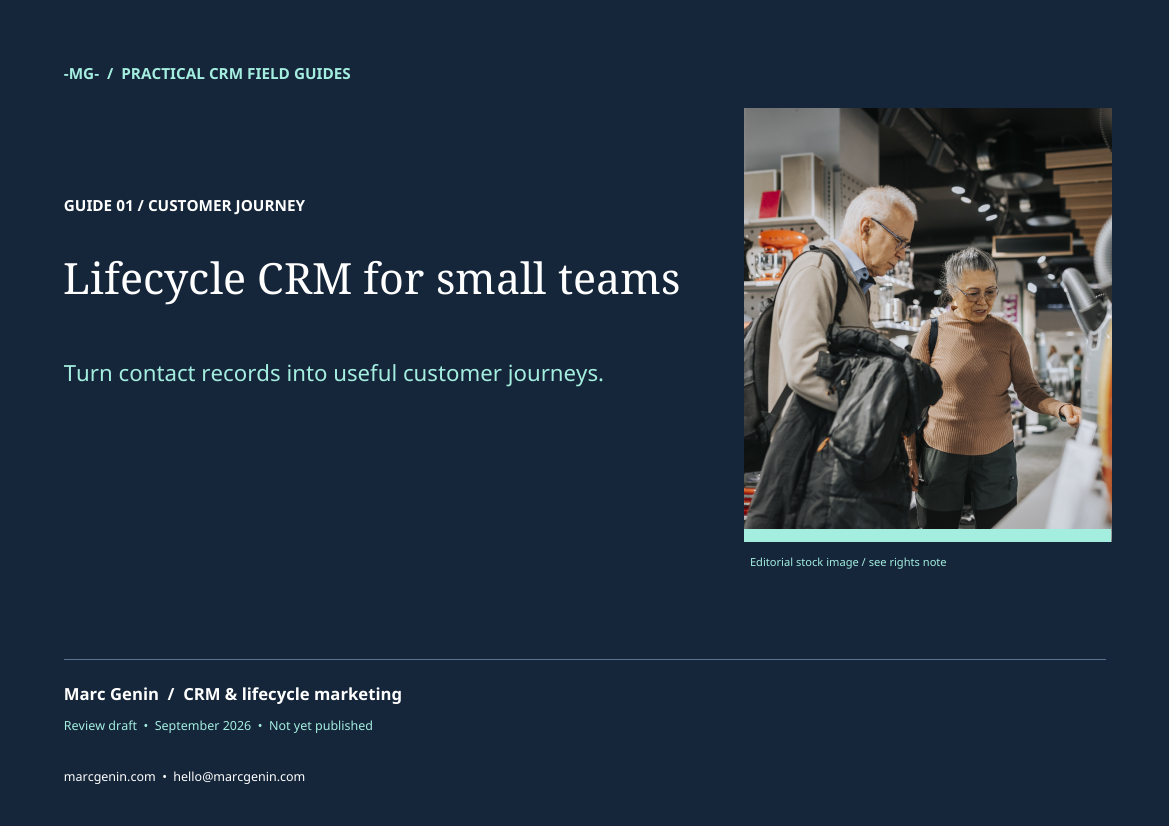
Build the lifecycle engine these agents plug into.
My PDF playbook Lifecycle CRM for Small Teams (Guide 01) gives you the exact CRM setup, flows and data model to run lifecycle marketing - with or without an AI agent doing the chasing.
Get the PDF playbook
I help SMBs and scale-ups build CRM and lifecycle marketing programs that turn AI from a reporting tool into a revenue engine. If you want a clear-eyed audit of where agents fit your stack, get in touch or explore my CRM playbooks.
Source: Klaviyo blog, "Klaviyo + Meta Muse: Let an AI Agent Run Your Campaigns and Flows", September 29, 2026:
https://www.klaviyo.com/blog/klaviyo-meta-muse-connector


AI in Marketing 2026: Big Companies Run AI at 86%, SMBs at 48% - Here Is How to Close the Gap
Most marketing teams are not asking "should we use AI?" anymore. They are asking "why is AI not moving our revenue yet?"
Fresh research from IAB Europe (its 2026 study, run across 50 ad executives in 44 European markets and reported by Digiday on September 24, 2026) gives us the clearest picture so far of where AI in marketing really stands. And the numbers tell a story most vendors will not put in their pitch decks.
AI marketing adoption in 2026: nearly universal, mostly shallow
Start with the headline: 86% of the surveyed executives (43 out of 50) say their organization already uses AI for marketing. Adoption is not the story anymore. Depth is.
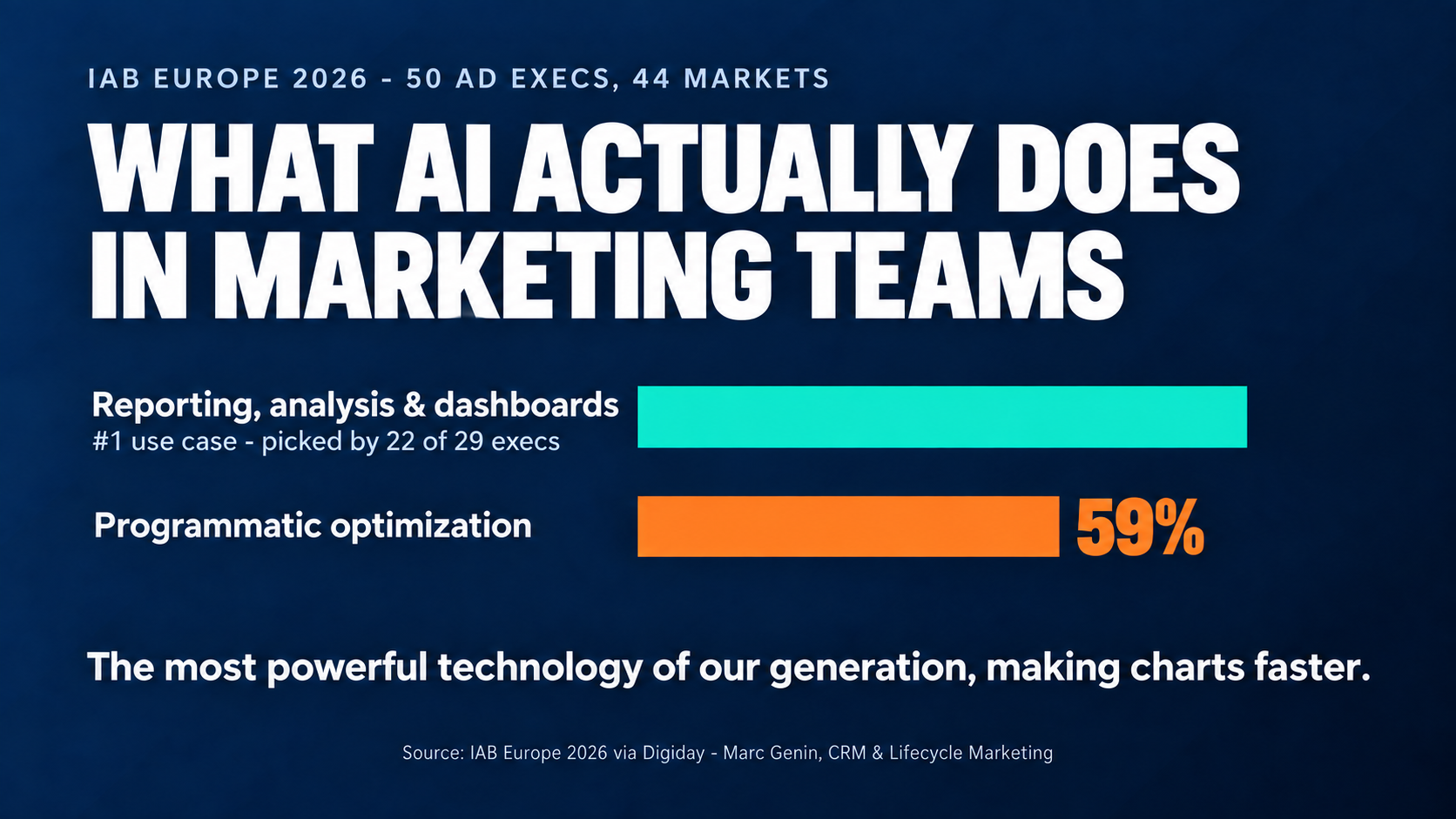
Ask what those teams actually do with AI, and the answer is surprisingly modest. The number one AI-supported workflow, picked by 22 of 29 executives, is reporting, analysis and dashboards. Programmatic optimization comes next at 59%.
In other words: the most common use of the most powerful technology of our generation is making charts faster.
That is not a criticism. Reporting is exactly where AI pays back fastest, because it is repetitive, rules-based and easy to measure. But it explains the next number.
How marketing teams measure AI success: efficiency, not outcomes
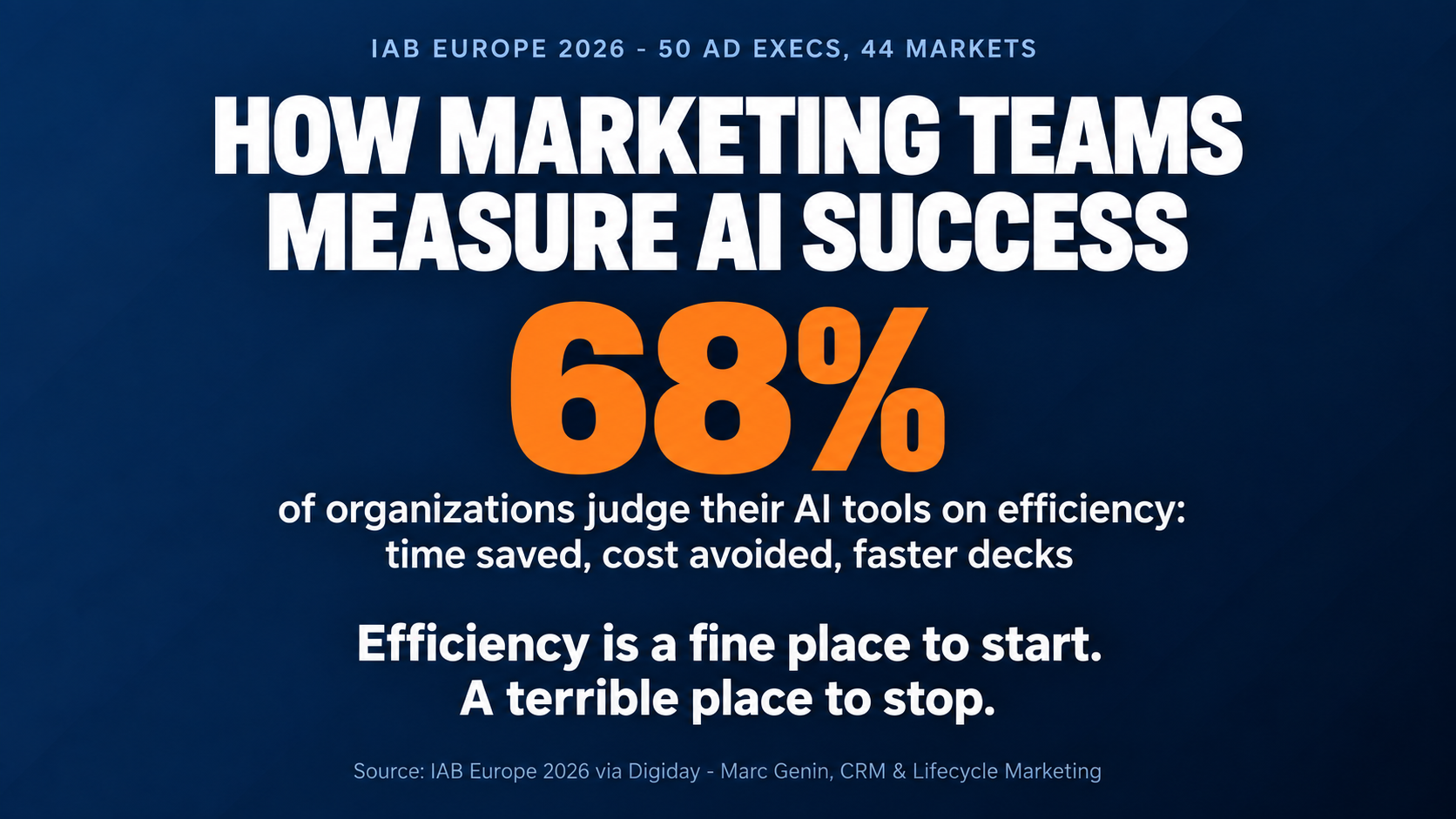
When IAB Europe asked how organizations judge their AI tools, 68% of respondents said efficiency. Time saved. Cost avoided. Faster decks.
Efficiency is a fine place to start. It is a terrible place to stop.
A CRM or lifecycle program judged only on efficiency will optimize what you already do. It will not find the customers you are losing, the journeys you are not running, or the revenue sitting in segments you have never built. If your AI strategy ends at "we produce reports faster", you are automating the past, not building the future.
The AI marketing size gap: 86% vs 48%
Here is the finding that matters most if you run or advise a small or mid-sized business.
Among companies with more than 500 employees, 86% already run their most advanced AI systems at a level where people and AI agents plan, delegate and execute work together. Among companies with 500 staff or fewer, that number drops to 48%.
Same technology. Same year. A 38-point gap.
Large organizations are buying their way into agentic workflows with dedicated teams and budgets. SMBs are not behind because they lack ambition. They are behind because nobody has shown them which three or four use cases actually pay for themselves at their scale.
Agentic AI in marketing: real, but earlier than the hype
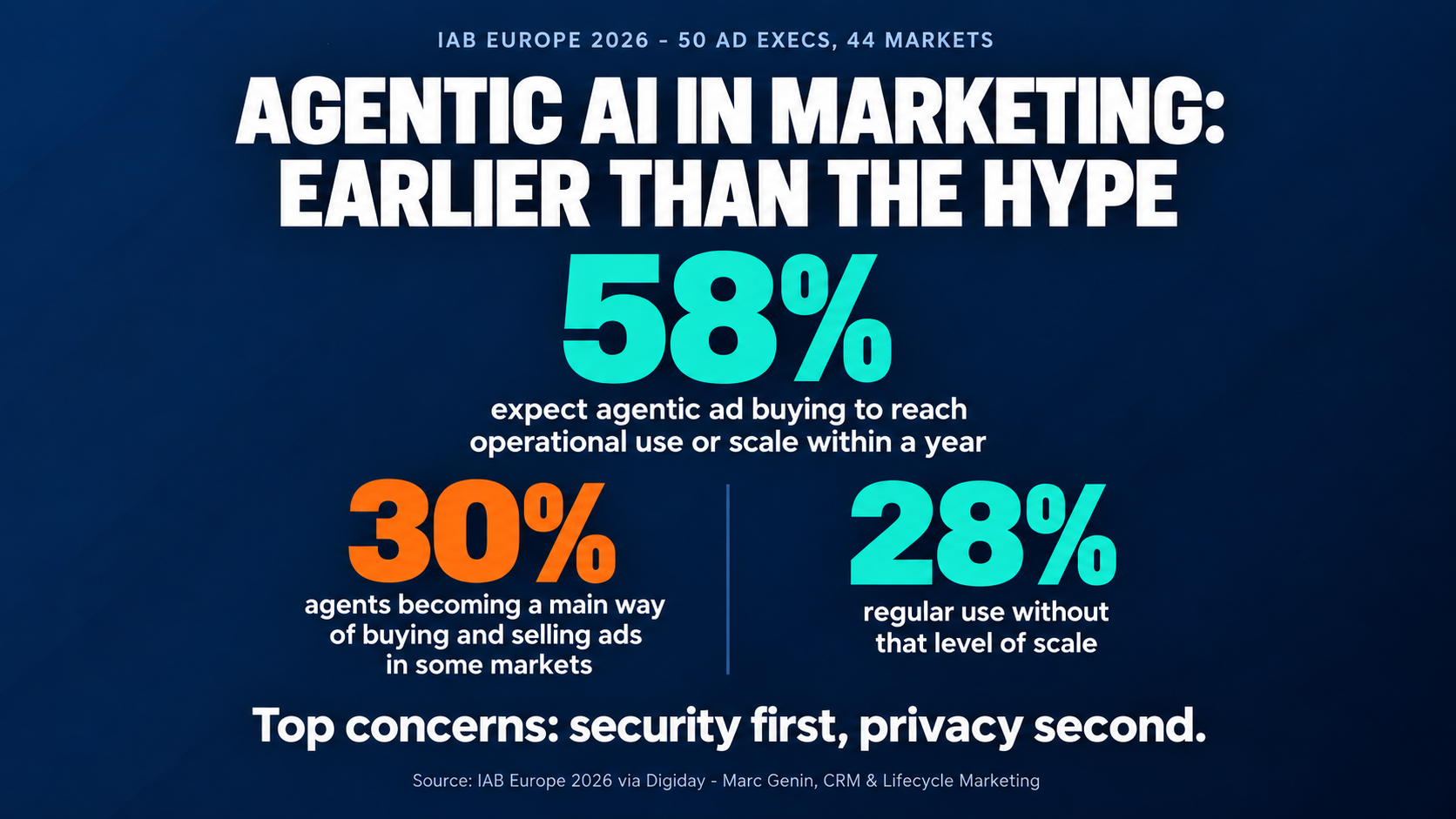
The study also cuts through the agentic AI noise. 58% of executives expect agentic ad buying to reach operational use or scale within a year, but the details matter:
- 30% expect AI agents to become a main way of buying and selling ads in some markets
- 28% expect regular use without that level of scale
- The rest expect further development with little day-to-day impact yet
And 36 of 47 executives say their organization either has no agentic system running day to day, or has one that humans still direct and plan alongside. The top concerns? Security first, privacy second.
So yes, agentic AI is coming to marketing. No, it is not running your campaigns while you sleep. Not yet, and not without supervision.
How SMBs close the AI marketing gap (without a bigger budget)
The good news: closing the gap is not a budget problem. It is a use-case problem. Here is the playbook I recommend to CRM and lifecycle marketing clients:
- Start where AI already wins. Reporting and analysis automation is proven, cheap and fast. Use it to free 5 to 10 hours a week, then reinvest those hours in the steps below.
- Wire AI into your CRM, not just your dashboards. The gap between "AI that reports" and "AI that sells" is data. Connect AI to your customer data platform or CRM so it can act on lifecycle stage, behavior and purchase history, not just describe them.
- Pick revenue use cases, not efficiency use cases. Churn-risk triggers, win-back journeys, next-best-offer personalization, lead scoring. These are the workflows where SMBs can match enterprise results, because they depend on focus, not headcount.
- Keep humans in the loop. Every serious operator in the study does. AI drafts, scores and flags. You decide. That is how you get speed without the security and privacy risks that worry executives most.
- Measure outcomes, then efficiency. Judge AI on revenue per campaign, retention rate and conversion lift first. Let efficiency be the bonus, not the goal.
The companies that win the next two years of AI marketing will not be the ones with the biggest AI budgets. They will be the ones that picked the right three use cases and wired them into their CRM properly. That game is wide open for SMBs, and 48% versus 86% is an opportunity, not a verdict.
Close the gap without burning your team.
My PDF playbook Marketing Automation That Survives Launch (Guide 03) shows how small teams ship AI marketing automation that keeps working after go-live.
Get the PDF playbook
I help SMBs and scale-ups build CRM and lifecycle marketing programs that turn AI from a reporting tool into a revenue engine. If you want a clear-eyed audit of where AI fits your stack, get in touch or explore my CRM playbooks.
Source: IAB Europe 2026 study, via Digiday, September 24, 2026: